
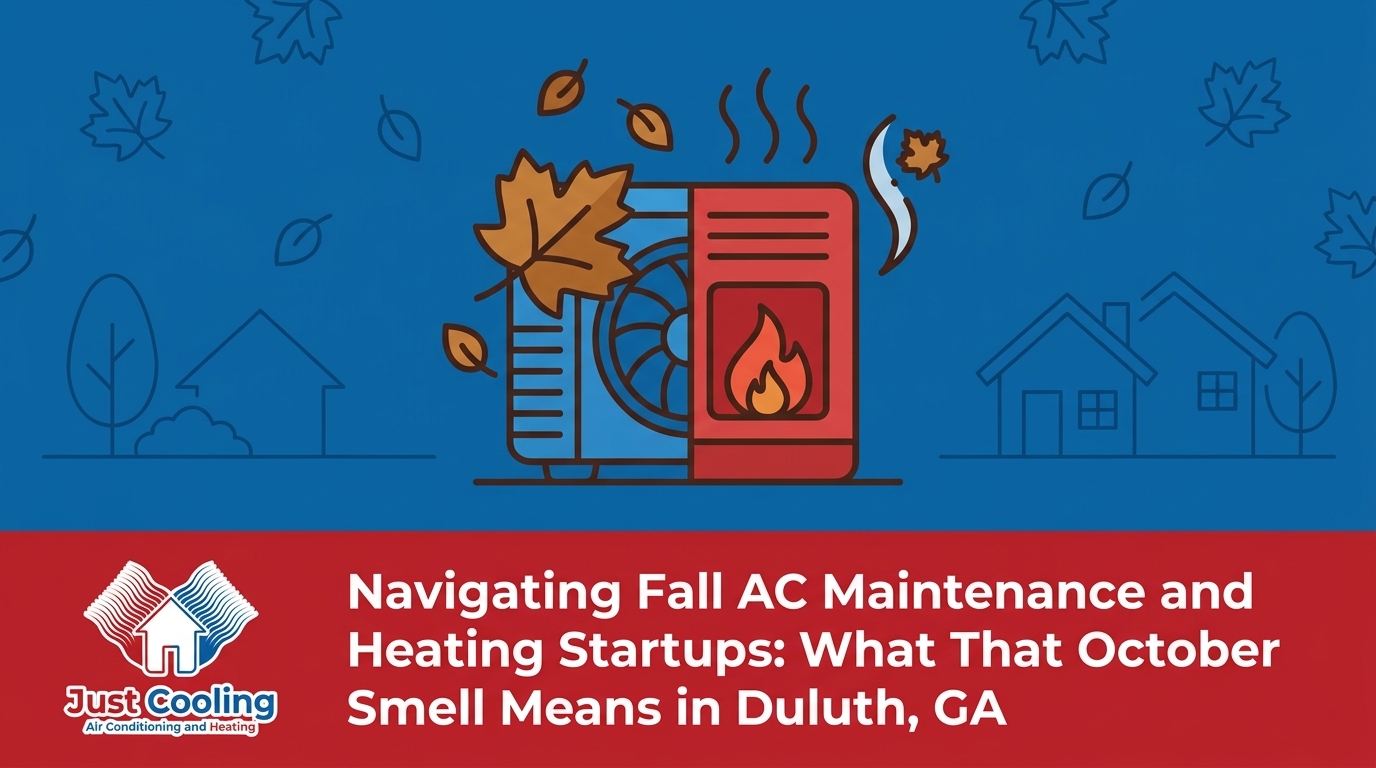
That First Chilly October Evening: The Cool-to-Heat Transition
When you switch your thermostat to heat for the first time this fall and a strange burning odor pours out of your vents, having access to local service expertise and area tips can help you determine if your home is in danger. Here at Just Cooling Air Conditioning and Heating, our team fields dozens of calls every October from homeowners panicked by that initial blast of warm air during a mid-fall heating startup. It often brings an unexpected and alarming scent, and it is completely normal to wonder if a wire is melting, a motor is burning out, or if the furnace itself is a fire hazard.
The sudden sensory shift: Transitioning from months of crisp, conditioned cooling to the sudden operation of high-temperature heating elements creates a distinct environmental change inside your ductwork. While some odors are a completely normal part of this seasonal transition, others serve as critical warning signs that demand immediate professional intervention. Understanding the difference between a harmless nuisance and a severe hazard is the key to protecting your home as the weather cools down.
If you are unsure about the safety of your system’s startup, exploring comprehensive HVAC Services can provide the peace of mind you need before the freezing temperatures arrive.
What to expect during the transition:
- Initial odors: A temporary scent similar to a warm, dusty radiator is standard for the first cycle.
- Auditory changes: You may hear the metal ductwork expanding as warm air pushes through cold pipes.
- Airflow adjustments: The first few minutes might push out stale air that has been trapped in the vents since summer.
Setting the stage for a safe winter means understanding exactly how your summer cooling cycles directly impact your fall heating performance. The two systems are intimately connected, sharing the same blower motor, ductwork, and physical cabinet space. What happens in July directly dictates what you smell in October.
The Science of the Smell: Duluth Humidity and Idle Heating Components
The underlying problem: Throughout the long, hot summer, your furnace’s heat exchanger and heating elements sit completely dormant in the dark, enclosed space of your HVAC cabinet. They are doing absolutely nothing while the air conditioning components work overtime.
The environmental cause: In our years of servicing North Georgia homes, we’ve seen how this dormancy is complicated by the local climate. Duluth’s summer humidity frequently exceeds 70%, creating a sticky, slightly damp environment inside the ductwork and the air handler. As the blower motor pushes cooled air through the house, airborne dust, pet dander, pollen, and microscopic particulates circulate through the system. Because the dormant heating components are metallic and often slightly damp from ambient summer humidity, this debris adheres strongly to their surfaces. Instead of just resting lightly on the metal, the dust forms a stubborn, baked-on layer over months of inactivity.
The physical solution: When you finally trigger the heating cycle, those metallic components rapidly heat up to hundreds of degrees. The initial cycle physically incinerates the accumulated layer of sticky dust and dander. That “burning” smell is exactly what it sounds like—the literal combustion of microscopic debris inside the furnace cabinet. This physical process is unavoidable, but its severity depends heavily on how clean your home’s air was during the summer.
Because the accumulation of this debris is directly tied to your system’s overall cleanliness, keeping up with regular AC maintenance throughout the cooling season dramatically reduces the severity of this fall burn-off. A system that operates with a clean filter and a well-maintained blower motor simply pushes less dust across the dormant heat exchanger.
Normal ‘Burning Dust’ vs. Dangerous Sensory Cues
Knowing exactly what to smell and listen for during an October mid-fall heating startup can prevent a minor component failure from turning into a major emergency. While the initial burn-off is a rite of passage for the season, we always advise our Duluth customers that your nose is often the first diagnostic tool for detecting a genuine hazard.
The Harmless ‘Burning Dust’ Scent
The sensory profile: The standard burn-off smells remarkably like a space heater that has just been plugged in, or a warm, dusty radiator. It is typically a dry, slightly stale odor that does not sting the eyes or throat.
The timeline: This scent is usually localized near the vents closest to the HVAC unit initially, and it should fade steadily after the first 15 to 30 minutes of continuous operation. If the smell is dissipating, the system is functioning exactly as it should.
Electrical Odors and Ozone Smells
The sensory profile: If you detect a sharp, acrid odor that resembles melting plastic, burning rubber, or the metallic tang of ozone (similar to an electric spark or a chlorine-like scent), you are dealing with a critical failure.
The underlying issue: This specific sensory cue almost always indicates overheating blower motors, seizing bearings, or melting wire insulation inside the cabinet. Summer vibrations can loosen electrical connections, causing them to arc and overheat when the high-voltage heating cycle engages. This requires immediate system shutdown at the thermostat to prevent an electrical fire.
Gas and Rotten Egg Warnings
The sensory profile: The most dangerous scent you can encounter during a startup is the distinct odor of rotten eggs or sulfur. Natural gas is naturally odorless, but utility companies add a chemical called mercaptan to give it this unmistakable, foul smell specifically as a safety warning.
The underlying issue: Smelling rotten eggs indicates uncombusted natural gas leaking into your home. This can be caused by a failed ignition sequence, a stuck gas valve, or a cracked heat exchanger. If you smell this, do not turn on lights or use electrical devices. Evacuate the home immediately and call emergency services or your local gas company from outside.
| Sensory Cue | Likely Cause | Required Action |
|---|---|---|
| Dry, dusty “radiator” smell | Normal dust burn-off on heat exchanger | Monitor; should fade in 30 minutes |
| Melting plastic or electrical burning | Failing motor, melted wiring, arcing | Shut down system immediately; call pro |
| Rotten eggs or sulfur (mercaptan) | Natural gas leak | Evacuate immediately; call gas company |
| Prolonged booming on startup | Delayed gas ignition (gas buildup) | Shut down system; schedule repair |

Wrapping Up Cooling Season: The Role of Post-Summer Maintenance
It is a common misconception that the air conditioner and the furnace operate in total isolation. In reality, a system’s heating performance is heavily dependent on how it was maintained during the cooling season. Because both functions share the same central air handler and ductwork, neglecting one inevitably compromises the other.
The shared airflow dilemma: During a humid Duluth GA summer, the evaporator coil extracts gallons of moisture from your indoor air. If that moisture mixes with a dirty air filter, it creates a sludgy buildup on the coil itself. A dirty evaporator coil from summer directly restricts the airflow your furnace desperately needs in the fall. When a furnace cannot push hot air out of the cabinet fast enough, the internal temperature spikes, causing the system’s high-limit safety switch to trip and shut down the heating cycle prematurely.
The condensate drain connection: Similarly, a clogged AC condensate drain line from August can leave standing water in the drain pan. As the weather cools, this stagnant water breeds biological growth and contributes to a musty, swampy odor that gets blasted through your house the moment the blower motor kicks on for heating.
The first line of defense: Changing the air filter is the absolute most important step in the seasonal transition. A filter that spent three months catching summer pollen and wildfire smoke is fully compacted by October. Forcing a newly ignited furnace to breathe through a suffocated filter puts massive strain on the blower motor, increasing energy consumption and accelerating wear and tear.
In our experience, skipping cooling maintenance often compounds into heating failures right when the system switches modes. Understanding when to service your AC system ensures that the shared components—the blower, the filter housing, and the ductwork—are pristine and ready to handle the intense thermal demands of winter heating.
Decision Framework: When to Open a Window vs. Shut Down the System
The problem: You have turned the heat on, the smell has arrived, and you are standing by the thermostat wondering what to do next. Indecision in this moment can lead to either unnecessary discomfort or a dangerous oversight.
The cause of confusion: Because the harmless dust burn-off and the early stages of a component failure both produce an odor, homeowners often struggle to interpret the severity of the situation. Without a clear diagnostic framework, it is easy to assume the worst or dangerously ignore a real problem.
The actionable solution: Follow a strict, time-based protocol to evaluate your system safely during an October mid-fall heating startup.
The 30-Minute Dissipation Rule
If you detect a standard dusty smell, monitor the intensity of the odor closely. The rule of thumb is simple: the smell should peak within the first five minutes and steadily weaken thereafter.
- Turn the thermostat to your desired heating temperature.
- Open a few windows to allow the initial burnt-dust air to ventilate out of the living space.
- Ensure your home has working smoke and carbon monoxide detectors as a passive safety backup.
- Wait exactly 30 minutes. If the smell is gone or barely noticeable, close the windows and enjoy the warmth.
Signs You Need Immediate Shutdown
There are exact scenarios where you must bypass the 30-minute rule entirely and turn the thermostat to ‘OFF’ immediately. Do not wait to see if these conditions improve:
- Escalating intensity: The burning smell grows stronger and more acrid over time rather than weaker.
- Visual confirmation: Visible smoke or a hazy mist emerges from the floor or ceiling registers.
- Rapid short-cycling: The furnace turns on, runs for 60 seconds, and abruptly shuts off, repeating this cycle continuously.
- Auditory alarms: You hear loud metallic scraping, grinding, or a heavy “boom” every time the burners ignite.
The risks of ignoring persistent, non-dust smells include compromised indoor air quality, severe carbon monoxide exposure, and potential electrical fire hazards. Acting quickly on warning signs prevents minor component issues from becoming full system failures. For instance, our technicians recently responded to a local homeowner who woke up to a freezing 54-degree house with shivering children during a bitter cold snap because a minor ignition component had quietly failed overnight. Because they called us for a professional response immediately, our team quickly identified the faulty part and restored the warm air before the house temperature dropped further. Prompt action saves systems.
If your system exhibits any of these shutdown warning signs, it is a clear indicator that the unit needs professional attention. In many cases, securing a summer tune-up for your AC helps catch the electrical and motor issues that cause these sudden fall breakdowns.
Inside a Professional Pre-Winter Safety Inspection
Homeowners are often hesitant to call for an inspection because they aren’t entirely sure what a technician actually does behind the closed doors of the furnace cabinet. Demystifying this process highlights why these checks are critical for winter safety.
At Just Cooling Air Conditioning and Heating, we believe in transparent diagnostics. Working with our honest local experts means you are walked through exactly what is being tested and why, ensuring you fully understand the health of your system and never pay for unnecessary repairs. A licensed technician follows a rigorous, step-by-step safety protocol that goes far beyond just changing a filter.
Heat Exchanger Integrity Checks
The critical barrier: The heat exchanger is the metal chamber where combustible gas actually burns. Its job is to transfer that intense heat to the air blowing into your home while keeping the toxic combustion exhaust (including carbon monoxide) safely sealed inside the metal flues to be vented outside.
The inspection process: Over years of expanding and contracting with extreme temperature changes, the metal of a heat exchanger can develop microscopic stress cracks. A professional technician uses specialized visual tools, combustion analysis meters, and sometimes specialized cameras to inspect this chamber. Verifying the integrity of the heat exchanger is crucial for preventing carbon monoxide exposure. If a crack is found, the system cannot be safely operated.
Electrical Connection Tightening
The vibration factor: Your HVAC system is essentially a large, vibrating machine. Months of heavy summer AC usage can cause the internal wire nuts, terminal screws, and electrical harnesses to gradually vibrate loose.
The safety verification: A technician will systematically test and tighten the electrical connections throughout the cabinet. They also verify the operation of the safety limit switches—the internal sensors that automatically shut the furnace down if it overheats or if the flame rolls out of the combustion chamber. Ensuring these safe ignition sequences operate flawlessly is non-negotiable.
This level of detailed assessment prevents sudden winter failures. In one instance, a customer’s HVAC unit simply refused to turn on as the first freeze approached. A careful, methodical assessment by our technicians quickly figured out the underlying electrical fault and resolved it safely, restoring the unit to full operation without the need for a massive system overhaul.
Because the stakes are so high, the US Fire Administration explicitly recommends having heating equipment inspected annually by a qualified professional to prevent winter house fires. A comprehensive approach to HVAC maintenance and repair is your best defense against cold-weather emergencies.
Enjoying a Safe and Comfortable Fall Season
Navigating an October mid-fall heating startup doesn’t have to be a stressful event. That initial burst of burning dust is a normal rite of passage for the season, signaling that your system is shaking off its summer hibernation and preparing to keep your family warm.
True peace of mind comes from knowing the definitive difference between a harmless, temporary odor and a mechanical hazard that requires immediate shutdown. By paying attention to the sensory cues of your system and acting decisively when things don’t smell or sound quite right, you protect both your equipment and your home.
If you have any lingering doubts about your system’s safety, efficiency, or the strange noises it makes on startup, do not hesitate to schedule a routine pre-winter inspection. A clear, reassuring breakdown of your system’s health ensures that when the deep winter freezes finally arrive, your home remains a safe, comfortable sanctuary.
Frequently Asked Questions
Why does my heater smell like burning when I turn it on?
The burning smell is usually caused by the physical incineration of dust and debris that settled on the heat exchanger over the summer. When the furnace fires up for the first time, these dormant components reach high temperatures rapidly, burning off the accumulated layer. This is a normal process, especially in humid climates where dust adheres strongly to internal parts.
How long does the burning smell last when turning on heat?
A normal dust burn-off scent should dissipate within 15 to 30 minutes of continuous operation. You can open a few windows to help ventilate the home during this initial cycle. If the smell persists for hours or grows noticeably stronger, shut the system down, as this indicates a deeper mechanical issue.
Is it safe to run the heater if it smells like burning?
It is safe to run the heater if the smell resembles warm, dry dust and begins to fade quickly. However, if the odor smells like melting plastic, electrical arcing, or rotten eggs, it is absolutely not safe to run the system. These specific scents indicate critical safety hazards that require immediate professional intervention.
When should I call a professional for furnace smells?
You should call a professional immediately if you smell ozone, melting wires, or if the initial dusty smell fails to go away after half an hour. Additionally, if the smell is accompanied by loud booming noises, grinding sounds, or rapid short-cycling, turn off the thermostat and schedule an inspection to prevent further damage.
How does Duluth’s summer humidity affect my furnace in the fall?
High summer humidity creates a slightly damp environment inside the shared HVAC cabinet, causing airborne dust and pet dander to stick stubbornly to the dormant heating components. Because this debris forms a baked-on layer rather than resting lightly on the metal, the resulting burn-off smell in the fall is often much more prominent and noticeable.